Best months to hike Taranaki
Want a volcano hike you can book?Nothing on Taranaki itself is sold on GetYourGuide. The Tongariro Alpine Crossing, a couple of hours east, is: a shuttle or a guide gets you across New Zealand's best-known volcano day hike, with Taranaki on the western skyline on a clear morning.
Compare the optionsJanuary to April: the summit season
The usual summit season is January to April. For the rest of the year the upper mountain has snow and ice and is a mountaineering climb needing crampons, an ice axe and avalanche skills. Even inside the season the crater often holds snow, so “summer” does not mean a bare mountain. I have reached the summit area in the late-summer season most years, and the thing that decides my day is never the month. It is whether the forecast is settled from morning to late afternoon. The route and timings are on how long the summit takes, and DOC’s season notes are on DOC’s Taranaki Maunga Summit Climb page.
Summer on the Pouākai Crossing
The Pouākai Crossing is 19 km one way and takes 7.5–9.5 hours, so long summer days give you the margin for the side trips to Te Rere-o-Tahurangi Falls and Pouākai Trig and a slow lunch at the tarns. In winter the crossing needs an ice axe, crampons and avalanche gear, which turns a hike into something else. My notes on the whole route are on the Pouākai Crossing page.
May to December: snow up high, forest below
From May the upper mountain belongs to people with mountaineering skills and gear. The lower slopes are another matter. The goblin forest of moss- and lichen-draped kāmahi around Dawson Falls and North Egmont is good in any season, and wet weather suits it. Dawson Falls is 10 minutes from the visitor centre, the Kapuni Loop takes about an hour, and the Veronica Loop at North Egmont is 3 km. One thing to watch after heavy rain: the Wilkies Pools Loop crosses the Kapuni Stream without a bridge, and it can be impassable. The full list is on short walks on Taranaki.
Cloud, wind and the forecast
The weather here changes fast in any month. The upper mountain often sits in cloud while the coast is sunny, and the other way round. Before every trip above the bushline I read the MetService mountain forecast for Te Papa-Kura-o-Taranaki, which gives the winds and the cloud base. For the summit, I leave by 09:00 at the latest, check every hour whether to carry on, and turn back if conditions change. Carry layers and a shell in every month, plus sun protection and water. Build a spare day into any trip where the summit matters to you, and keep a forest walk in your pocket for the day the cloud wins.
Dawn at the Pouākai Tarns
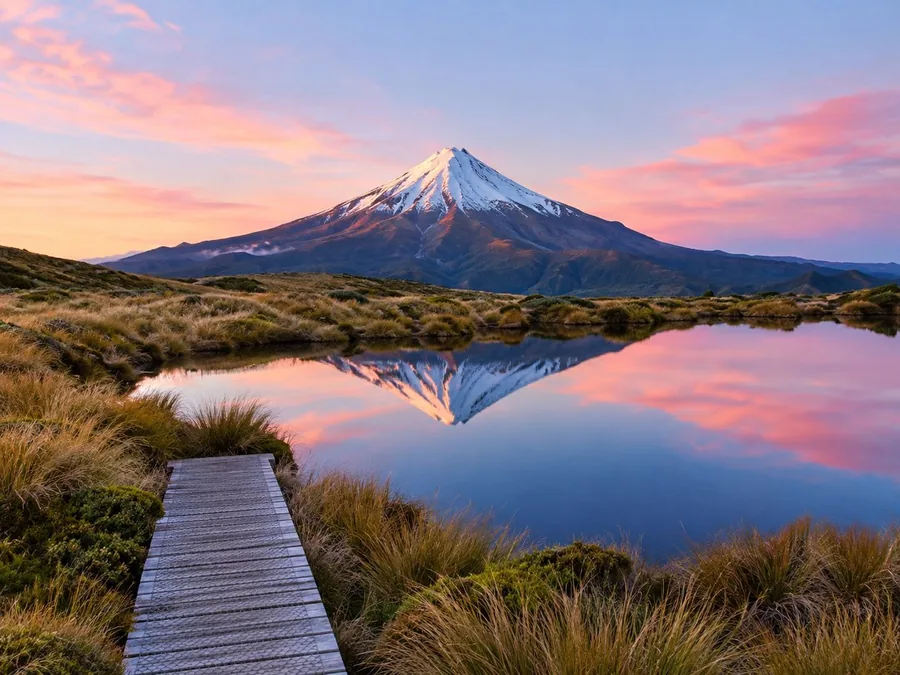
The reflection of Taranaki in the Pouākai Tarns is the photograph everyone wants, and it needs still air, which you are most likely to get early in the morning. The Mangorei Track reaches Pouākai Hut in about 2 hours on steps and boardwalk, and the tarns are about 10 minutes further. To be there at first light you either walk up by headtorch or spend the night at the hut, which must be booked all year. There is no camping at the hut or the tarns. The overnight version is on Taranaki’s multi-day tramps.
If the forecast shows a clear, calm morning after a clear night, that is the dawn to go for. A breeze of any strength breaks the reflection.
Around the Mountain: October to April
The Around the Mountain Circuit, about 52 km over 4–5 days, is best from October to April. Even then it is for experienced trampers with navigation skills.
When the mountain is in cloud
GetYourGuide sells nothing on Taranaki itself, and you don’t need a tour: every track here starts from a public road end, and shuttles run from New Plymouth to North Egmont in season. If your Taranaki days are clouded in and you would still like an easy volcano walk you can book, this is the one I would suggest: the half-day guided walk at Tongariro, a few hours east. It runs for 4 hours from National Park Village, with a safety briefing, a short coach ride and about 3 hours of guided walking on the start of the Crossing track to the Soda Springs waterfall below Mount Ngāuruhoe. It suits low fitness and families, and in winter the guides supply crampons and ice axes. On a good day you can upgrade to the full crossing, if conditions and logistics allow. Water, snacks and lunch are not included. Full refund if you cancel up to 14 days ahead.
Frequently asked questions
When is the best time to climb Mount Taranaki?
January to April, the usual summit season. Pick a day with a settled forecast and leave by 09:00 at the latest.
Can you climb Taranaki in winter?
Only as a mountaineering climb. From May to December the upper mountain has snow and ice, and you need crampons, an ice axe, a helmet and avalanche gear. Why that matters is on how hard the Taranaki hike is.
When is the best time for the Pouākai Crossing?
The long days of summer, in settled weather. In winter it needs an ice axe, crampons and avalanche gear.
Is Taranaki worth visiting in winter?
Yes, for the forest walks at Dawson Falls, North Egmont and the Stratford Plateau, which are good all year. Just leave the upper mountain to people with mountaineering skills.
Does the summit have snow in summer?
Often, in the crater. Even in the January–April season the crater can hold snow and ice.