How hard is the Taranaki hike?
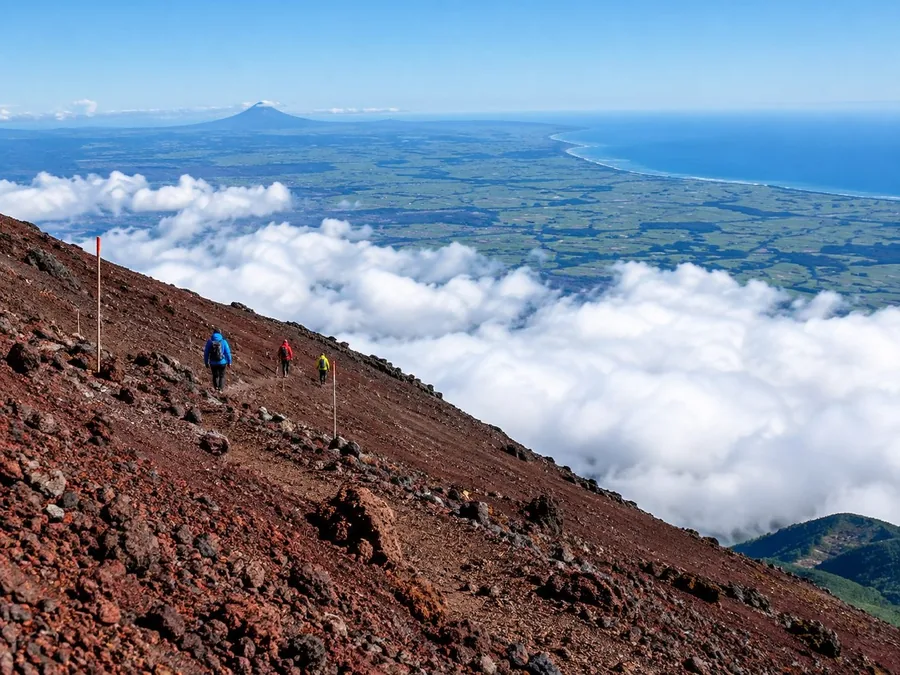
Hard. The summit of Taranaki Maunga (formerly Mount Egmont) is a long, steep day: about 1,570 m of climbing in about 6.3 km, steep loose scoria near the top, a rocky ridge where you use your hands, and weather that changes fast. DOC allows about 9 hours return. In the January–April season it suits fit, sure-footed hikers with experience of big days. From May to December it is a mountaineering climb.
Want a volcano hike you can book?Nothing on Taranaki itself is sold on GetYourGuide. The Tongariro Alpine Crossing, a couple of hours east, is: a shuttle or a guide gets you across New Zealand's best-known volcano day hike, with Taranaki on the western skyline on a clear morning.
Compare the optionsWhat makes it hard
The climb. About 1,570 m up from the North Egmont road end, most of it in the last 2.3 km. That is roughly twice the climb of the Tongariro Alpine Crossing, about 1,570 m against about 770 m, on a shorter route. The two are compared on Taranaki or Tongariro.
The scoria. Above the steps out of the Hongi Valley, the route crosses steep slopes of loose volcanic gravel. Going up, each step slides back. Coming down, it is where tired legs need the most care.
The Lizard. A rocky ridge at 2,134 m where you need your hands on the rock. It is not technical in summer conditions, but it asks for a steady head and three points of contact.
The weather and the crater. Cloud can close in on the upper mountain in the time it takes to eat lunch, and the crater often holds snow and ice even in the January–April season.
Who can do it
In season, I would say yes to anyone who has done several long, steep day hikes, is comfortable on loose ground going downhill, and doesn’t mind using their hands on rock. You don’t need mountaineering skills from January to April. You do need the fitness to keep going for 9 hours and the judgement to turn round. From May to December the upper mountain has snow and ice, and the route needs crampons, an ice axe, a helmet, an avalanche transceiver, probe and shovel, and the experience to use them.
How I would train for it
- Walk the Mangorei Track to Pouākai Hut and back. It is mostly steps, and it tells you quickly how your legs handle a long climb.
- Do the Pouākai Crossing as a test day. If 19 km felt comfortable, the summit is a fair next step.
- Practise going downhill with the pack you will carry. The descent is where the summit tires people.
- Break in your boots on long days first, not on the mountain.
The honest numbers
More than 70 people have died on Taranaki Maunga since records began. Most summit accidents involve slips on ice or fast-changing weather. Go only in settled weather, start early, and turn back if conditions change.
What keeps a day up there safe
The people I know who enjoy this mountain for years all do the same things. They go in the January–April season and on a settled day, after reading the MetService mountain forecast for the wind and the cloud base. They leave by 09:00 at the latest, reassess every hour and turn back when conditions change, which is the advice from the NZ Mountain Safety Council’s advice for the maunga. They stay on the poled route. They carry layers and a shell in any month, sun protection, plenty of water, sturdy boots and a personal locator beacon, which you can hire at the North Egmont visitor centre. Done like that, a summit day is a hard, safe and very good day out. DOC’s current notes are on DOC’s summit climb page.
The maunga is a sacred ancestor to the eight iwi of Taranaki. Please don’t stand directly on the highest point, and don’t camp, cook, go to the toilet or leave litter in the summit area.
Easier ways up high
If the summit is more than you want this trip, there is plenty of high ground below it. The Pouākai Crossing is 19 km on an alpine tramping track, with the cone in front of you most of the day; my notes are on the Pouākai Crossing, step by step. The Mangorei Track reaches Pouākai Hut in about 2 hours on steps and boardwalk, with the tarns about 10 minutes further. From Dawson Falls, Panitahi (Fanthams Peak), at 1,966 m, is a 5–6 hour return walk; it is still exposed and alpine, so treat it with the same care. All of them are side by side on the best hikes on Taranaki.
Decide on your turnaround time at breakfast and tell someone what it is. It is much easier to keep to a promise made at the kitchen table than one made at The Lizard.
How it compares nationally
There is no official ranking, but the summit turns up on every list of New Zealand’s toughest day hikes, next to Avalanche Peak and the Mueller Hut Route. Where it sits is on New Zealand’s toughest day hikes.
A hard volcano day you can book
Nothing on Taranaki itself is sold on GetYourGuide, and you don’t need a tour: the summit starts from a public road end. If you want a big volcano day with the transport arranged, this is the one I would pick: the Tongariro Alpine Crossing, a few hours east, with a shuttle from Taupō at each end and 6–8 hours hiking on your own. Barbara, from Germany, recommends it “if you are fit and have the right gear”. Weather cancellations happen; the shuttle then offers a full refund or another day.
Or with a guide
If the difficulty is the worry, the premium guided crossing puts a guide beside you for about 8 hours on the track, and in winter it supplies crampons and ice axes. No alpine experience is needed, but the fitness is. Richard, from the United States, called it “physically exhausting for the occasional hiker”, which is fair. Its refund window is 14 days.
Frequently asked questions
How difficult is the Mount Taranaki hike?
Hard: about 1,570 m of climbing, steep loose scoria and a rocky ridge at The Lizard where you use your hands. DOC allows about 9 hours return. In January–April it suits fit, sure-footed hikers.
Is Taranaki dangerous to hike?
It is a serious mountain, and a safe day in the right conditions: the January–April season, a settled forecast, an early start, the poled route, and turning back if the weather changes.
Do you need mountaineering experience for the Taranaki summit?
Not from January to April, when it is a hike with some hands-on rock. From May to December the upper mountain has snow and ice and needs mountaineering skills, crampons, an ice axe and avalanche gear.
How long does the Taranaki summit take?
About 9 hours return, DOC says; 5–6 up and 3–4 down is typical. The stops are on how long the summit climb takes.
When is the best time to hike Taranaki?
For the summit, January to April. The forest walks go all year. The months are compared on the best time to hike Taranaki.