How long the summit climb takes
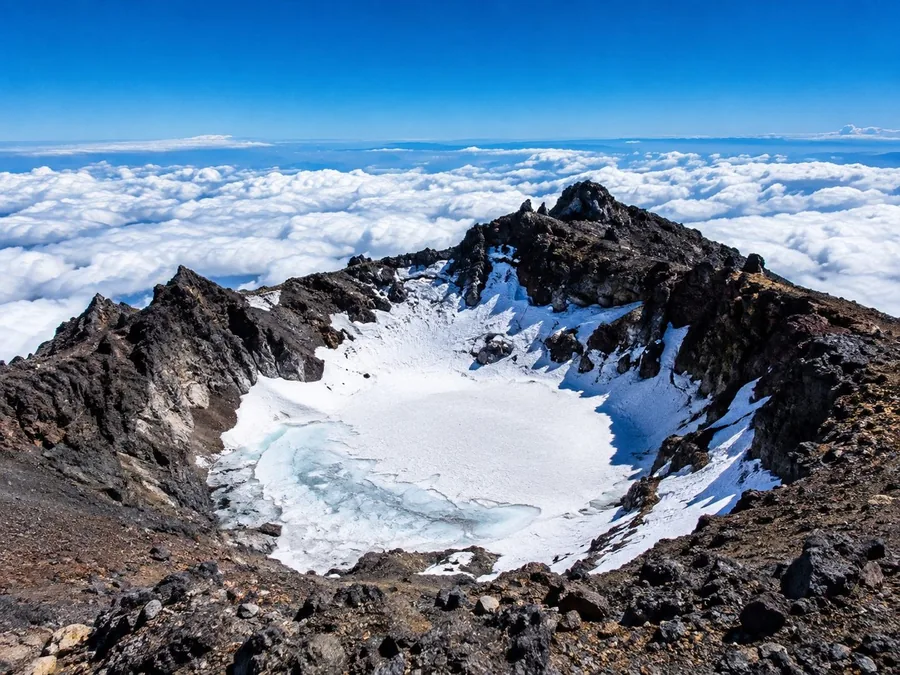
DOC says to allow about 9 hours to hike to the summit of Taranaki Maunga (formerly Mount Egmont) and back. Most fit hikers take 8–10 hours: 5–6 hours up and 3–4 hours down. The route starts at the North Egmont road end (946 m) and gains about 1,570 m to the summit area at 2,518 m, about 12.6 km return. The usual season is January to April.
Want a volcano hike you can book?Nothing on Taranaki itself is sold on GetYourGuide. The Tongariro Alpine Crossing, a couple of hours east, is: a shuttle or a guide gets you across New Zealand's best-known volcano day hike, with Taranaki on the western skyline on a clear morning.
Compare the optionsWhere the hours go
The 9 hours aren’t spread evenly. The first 4 km, up a gravel road to Tahurangi Lodge, takes 1 h 30–2 h. The last 2.3 km, from the lodge to the summit, takes 3–4 hours on its own, because that is where the steep scoria and the rock are. Coming down is quicker, but not by as much as people hope. Loose scoria is slow to descend with care, and tired legs make it slower.
I have reached the summit area in the late-summer season most years, and I still plan every trip on the full 9 hours. Anything less is a bonus. The people I see struggling on the way down are usually the ones who planned on the fast end of the range.
The route, stop by stop
- North Egmont road end, 946 m. The car park and the visitor centre, where you can hire a personal locator beacon. A boardwalk leads to a locked gate and a stile.
- Translator Road. A gravel road, open to walkers only, climbing steadily out of the forest.
- Tahurangi Lodge, 1,492 m. 4 km and 1 h 30–2 h from the car park. It is a private club lodge, not open to the public, but it is the natural place to check the sky and the time.
- The Hongi Valley. The poled route begins here, through a valley covered in rock. From now on, follow the poles.
- The steps. A long run of steps takes you up out of the valley.
- The scoria slopes. Steep, loose gravel. Each step up slides back a little, and for most people this is the slowest part of the day.
- The Lizard, 2,134 m. A rocky ridge where you need your hands on the rock. I find it easier going than the scoria below it, because the footing is firm.
- The crater. It often holds snow and ice even in the January–April season.
- The summit area, 2,518 m. The second-highest point in the North Island, after Ruapehu. On a clear day the whole province is laid out below you.
The maunga is a sacred ancestor to the eight iwi of Taranaki. Please don’t stand directly on the highest point, and don’t camp, cook, go to the toilet or leave litter in the summit area.
When to leave the car park
The advice from the NZ Mountain Safety Council’s advice for the maunga is to leave by 09:00 at the latest, reassess every hour and turn back if conditions change. I like to be walking well before that. An early start gives you the settled morning hours on the scoria and daylight in hand for the descent. Before I drive up, I read the MetService mountain forecast for the wind and the cloud base, and I decide my turnaround time at home, not on the mountain.
The season: January to April
The usual summit season is January to April. For the rest of the year the upper mountain has snow and ice and is a mountaineering climb needing crampons, an ice axe and avalanche skills. Summer does not guarantee a clear crater, so ask at the visitor centre about the conditions on the day. How the months compare for the other tracks is on the best time to hike Taranaki.
What I carry
- Warm layers, a hat, gloves and a waterproof shell, in any month.
- Sun protection. The upper mountain is open to the sun all day.
- Water and food for the whole day, plus a spare snack for the way down.
- Sturdy boots with a good grip for the scoria and the rock.
- A personal locator beacon; you can hire one at the North Egmont visitor centre.
- Poles for the descent. My knees are grateful every time.
Set a turnaround time before you leave home and keep to it, even if the summit looks close. The scoria is still there next week; a long descent in fading light is the part of the day I plan around.
Getting to the start
North Egmont is about 30 minutes from New Plymouth: turn off SH3 at Egmont Village and follow Egmont Road 16 km to the end. Check DOC’s North Egmont page before you go — parking at the road end can be limited, so carpool or take a shuttle. Shuttles also run from New Plymouth in season. The details are on getting to the Taranaki tracks, and DOC keeps the route notes on DOC’s summit climb page.
A word on the name
Since 1 April 2025, Taranaki Maunga and its neighbouring peaks have been recognised in New Zealand law as a legal person, Te Kāhui Tupua. The national park, formerly Egmont National Park, is now called Te Papa-Kura-o-Taranaki. Visitors are still welcome. People still search for “Mount Egmont”, which is why this site’s name keeps it; the story is on Mount Egmont or Taranaki Maunga.
If Taranaki is in cloud
Nothing on Taranaki itself is sold on GetYourGuide, and you don’t need a tour: the summit route starts from a public road end. If the cloud sits on the maunga all week, the Tongariro Alpine Crossing, a few hours’ drive east, is the other big volcano day. This shuttle leaves early from Taupō, drops you at Mangatepopo and collects you at the Ketetahi end, and you hike the crossing on your own. Catherine, from the United Kingdom, noted there is no guide on the walk, but the driver “gives a little introduction and map”. From the Devil’s Staircase you can see Taranaki on the western skyline on a clear day.
If you want a guide, or it is winter
From May to December the Taranaki summit is a mountaineering climb, and I wouldn’t send a friend up without those skills. The Tongariro guided crossing is the bookable winter alternative: a full day from National Park Village with the guides, and crampons and ice axes supplied in winter. Lunch isn’t included, and the refund window is 14 days, not 24 hours. All four Tongariro options are compared on the Tongariro Crossing tours page.
Frequently asked questions
How long does it take to climb Mount Egmont, now Taranaki Maunga?
DOC says allow about 9 hours return. Most fit hikers take 8–10 hours: 5–6 up and 3–4 down, for about 12.6 km and about 1,570 m of climbing from North Egmont.
How long is it from Tahurangi Lodge to the summit?
About 2.3 km, and DOC allows 3–4 hours. It is the steep part: the Hongi Valley, the steps, the scoria and The Lizard. The road up to the lodge takes 1 h 30–2 h.
Can you do the Taranaki summit in one day?
Yes. In the January–April season it is a long day hike: leave by 09:00 at the latest and turn back if conditions change. What makes it hard is on how hard the Taranaki hike is.
What time should I start the summit climb?
Early. The NZ Mountain Safety Council says leave by 09:00 at the latest; I like to be walking well before that, with a turnaround time already decided.
Is there a shorter high walk than the summit?
Yes. The Pouākai Crossing stays lower and looks back at the cone all day; it is on the Pouākai Crossing, step by step.